Showing New York City, New York · default city
Place list: GeoNames (CC BY 4.0). Times are for the city center and a flat horizon.
The next solar eclipses you can see from New York City, New York
Local times, how much of the sun the moon will cover at the deepest moment, and what it will look like.
Next · Partial eclipse here
Wednesday, January 26, 2028
3% of the sun covered
- Begins
- 9:17 AM
- Deepest
- 10:01 AM
- Ends
- 10:47 AM
After that · Partial eclipse here
Sunday, January 14, 2029
41% of the sun covered
- Begins
- 11:25 AM
- Deepest
- 12:50 PM
- Ends
- 2:10 PM
Then · Partial eclipse here
Wednesday, March 30, 2033
1% of the sun covered
- Begins
- 2:26 PM
- Deepest
- 2:47 PM
- Ends
- 3:07 PM
Next total solar eclipse in New York City: searching…
The eclipse of the decade
The total solar eclipse of August 2, 2027
On Monday, August 2, 2027, the moon's shadow crosses Morocco, southern Spain, Algeria, Libya, Egypt, Saudi Arabia, Yemen and Somalia, while most of Africa, Europe, the Middle East and west and south Asia see a partial eclipse.[32] At the point of greatest eclipse, in southern Egypt, the sun stays completely hidden for 6 minutes 23 seconds, an unusually long totality. By our calculation, Luxor gets 6m 25s of totality with the sun almost overhead.
In London the moon covers 42% of the sun at 10:00 AM local time, in Delhi 8% at 4:29 PM. The eclipse is not visible from the Americas, Australia or East Asia.
Along the path of totality
| Place | Deepest (local) | What you see |
|---|---|---|
| Cádiz, Spain | 10:46 AM | Total, 2m 54s |
| Málaga, Spain | 10:48 AM | Total, 1m 51s |
| Seville, Spain | 10:47 AM | Partial, 98% covered |
| Madrid, Spain | 10:51 AM | Partial, 86% covered |
| Gibraltar | 10:47 AM | Total, 4m 29s |
| Tangier, Morocco | 8:47 AM | Total, 4m 54s |
| Tunis, Tunisia | 10:09 AM | Partial, 97% covered |
| Benghazi, Libya | 11:30 AM | Total, 6m 13s |
| Luxor, Egypt | 1:05 PM | Total, 6m 25s |
| Cairo, Egypt | 12:55 PM | Partial, 95% covered |
| Jeddah, Saudi Arabia | 1:25 PM | Total, 6m 03s |
| Mecca, Saudi Arabia | 1:26 PM | Total, 5m 09s |
| Riyadh, Saudi Arabia | 1:32 PM | Partial, 76% covered |
From major cities
| City | Deepest (local) | Sun covered |
|---|---|---|
| Dubai, United Arab Emirates | 2:43 PM | 53% |
| London, UK | 10:00 AM | 42% |
| Singapore | 7:36 PM | 40% |
| Bengaluru, Karnataka, India | 4:53 PM | 39% |
| Dublin, Ireland | 9:56 AM | 36% |
| Manchester, UK | 9:59 AM | 35% |
| Chennai, Tamil Nadu, India | 4:54 PM | 34% |
| Mumbai, Maharashtra, India | 4:41 PM | 32% |
| Nairobi, Kenya | 2:01 PM | 31% |
| Karachi, Pakistan | 3:57 PM | 29% |
| Edinburgh, UK | 10:00 AM | 27% |
| Hyderabad, Telangana, India | 4:47 PM | 27% |
| Delhi, India | 4:29 PM | 8% |
| Kolkata, West Bengal, India | 4:43 PM | 6% |
| Lagos, Nigeria | 10:13 AM | 2% |
Not visible from: New York City, Miami, Chicago, Houston, Denver, Phoenix, Los Angeles, Seattle, Anchorage, Honolulu, Toronto, Vancouver, Manila, Sydney, Melbourne, Brisbane, Perth, Adelaide, Darwin, Auckland, Johannesburg, Cape Town.
Every solar eclipse in the next 10 years
There are two to five solar eclipses each year, but each is seen only from part of the world. Next to every eclipse are the cities from our list where the moon covers at least 10% of the sun.[11]
| Date (UTC) | Type | Seen from (most covered first) |
|---|---|---|
| Feb 6, 2027 | Annular | Lagos 84% |
| Aug 2, 2027 | Total | Cádiz 100%, Málaga 100%, Gibraltar 100%, Tangier 100%, Benghazi 100%, Luxor 100% and 19 more |
| Jan 26, 2028 | Annular | Cádiz 83%, Tangier 83%, Gibraltar 83%, Seville 83%, Málaga 83%, Madrid 82% and 9 more |
| Jul 22, 2028 | Total | Sydney 100%, Darwin 88%, Brisbane 81%, Melbourne 81%, Adelaide 76%, Auckland 68% and 3 more |
| Jan 14, 2029 | Partial | Vancouver 73%, Seattle 71%, Denver 64%, Chicago 58%, Phoenix 53%, Toronto 52% and 4 more |
| Jun 12, 2029 | Partial | Edinburgh 17%, Manchester 15%, Anchorage 12% |
| Jul 11, 2029 | Partial | None of the cities in our list |
| Dec 5, 2029 | Partial | None of the cities in our list |
| Jun 1, 2030 | Annular | Tunis 82%, Benghazi 82%, Tangier 70%, Gibraltar 69%, Málaga 69%, Cádiz 68% and 14 more |
| Nov 25, 2030 | Total | Johannesburg 97%, Brisbane 97%, Adelaide 91%, Sydney 79%, Perth 77%, Melbourne 75% and 3 more |
| May 21, 2031 | Annular | Bengaluru 84%, Chennai 83%, Singapore 82%, Nairobi 75%, Darwin 68%, Hyderabad 68% and 12 more |
| Nov 14, 2031 | Total | Honolulu 58%, Miami 38%, Houston 16% |
| May 9, 2032 | Annular | Cape Town 63%, Johannesburg 36% |
| Nov 3, 2032 | Partial | None of the cities in our list |
| Mar 30, 2033 | Total | Anchorage 97%, Vancouver 63%, Seattle 59%, Los Angeles 26%, Edinburgh 25%, Denver 23% and 4 more |
| Sep 23, 2033 | Partial | None of the cities in our list |
| Mar 20, 2034 | Total | Lagos 100%, Luxor 91%, Riyadh 91%, Jeddah 90%, Mecca 89%, Dubai 81% and 14 more |
| Sep 12, 2034 | Annular | None of the cities in our list |
| Mar 9, 2035 | Annular | Auckland 84%, Melbourne 76%, Adelaide 65%, Sydney 62%, Perth 62%, Brisbane 39% |
| Sep 2, 2035 | Total | Delhi 68%, Honolulu 60%, Kolkata 39%, Mumbai 36%, Hyderabad 27%, Bengaluru 14% and 2 more |
| Feb 27, 2036 | Partial | Auckland 14% |
| Jul 23, 2036 | Partial | None of the cities in our list |
| Aug 21, 2036 | Partial | Edinburgh 64%, Manchester 62%, London 60%, Dublin 60%, Madrid 40%, Tunis 39% and 6 more |
How to watch a solar eclipse safely
Never look straight at the sun, even when most of it is covered: the thin crescent that remains is still bright enough to burn the retina, and it doesn't hurt while it happens. Use eclipse glasses or a handheld solar viewer that meets the ISO 12312-2 standard, and throw them away if they are scratched or damaged. Ordinary sunglasses are not safe. A pinhole projector, even a piece of card with a small hole in it, lets you watch the sun's image on the ground safely. Never look at the sun through a camera lens, binoculars or a telescope: they need a proper solar filter attached to the front.[13]
Only during totality, when the moon covers the sun completely and the sky goes dark, is it safe to look with the naked eye. Put the glasses back on as soon as the first bright point of the sun reappears.
Total, annular or partial?
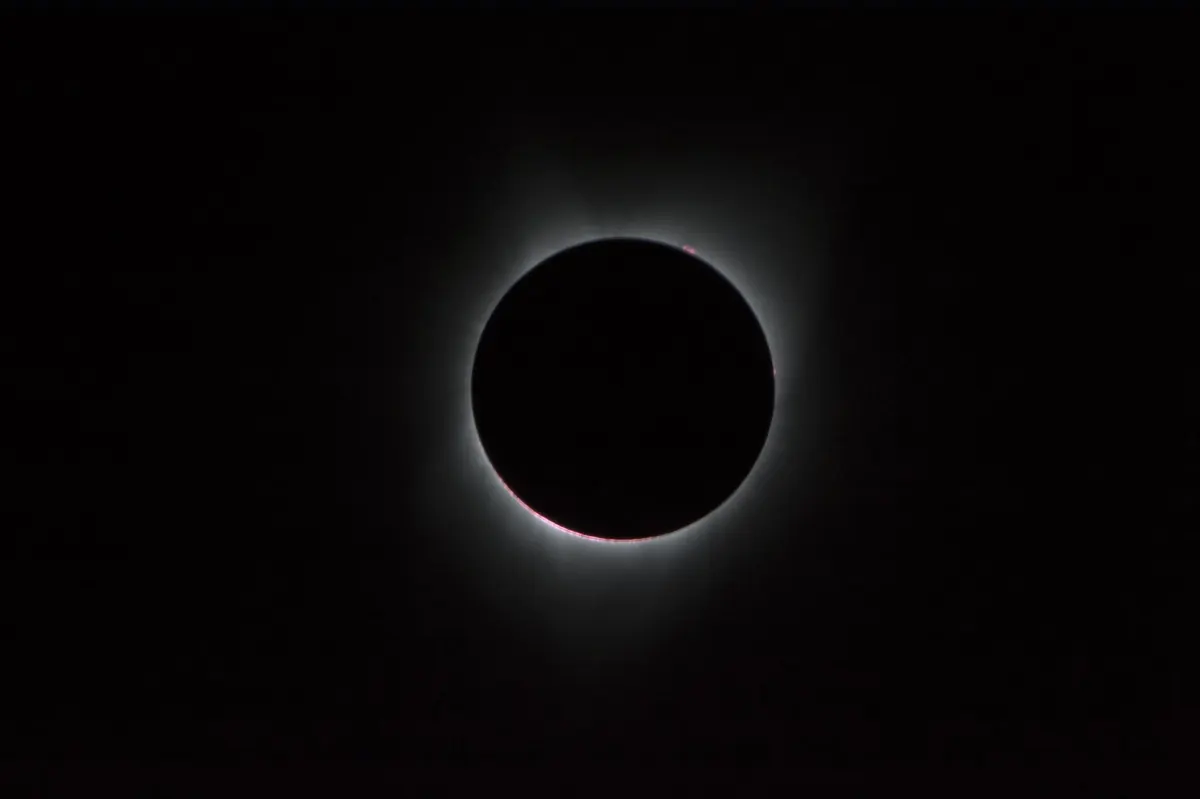
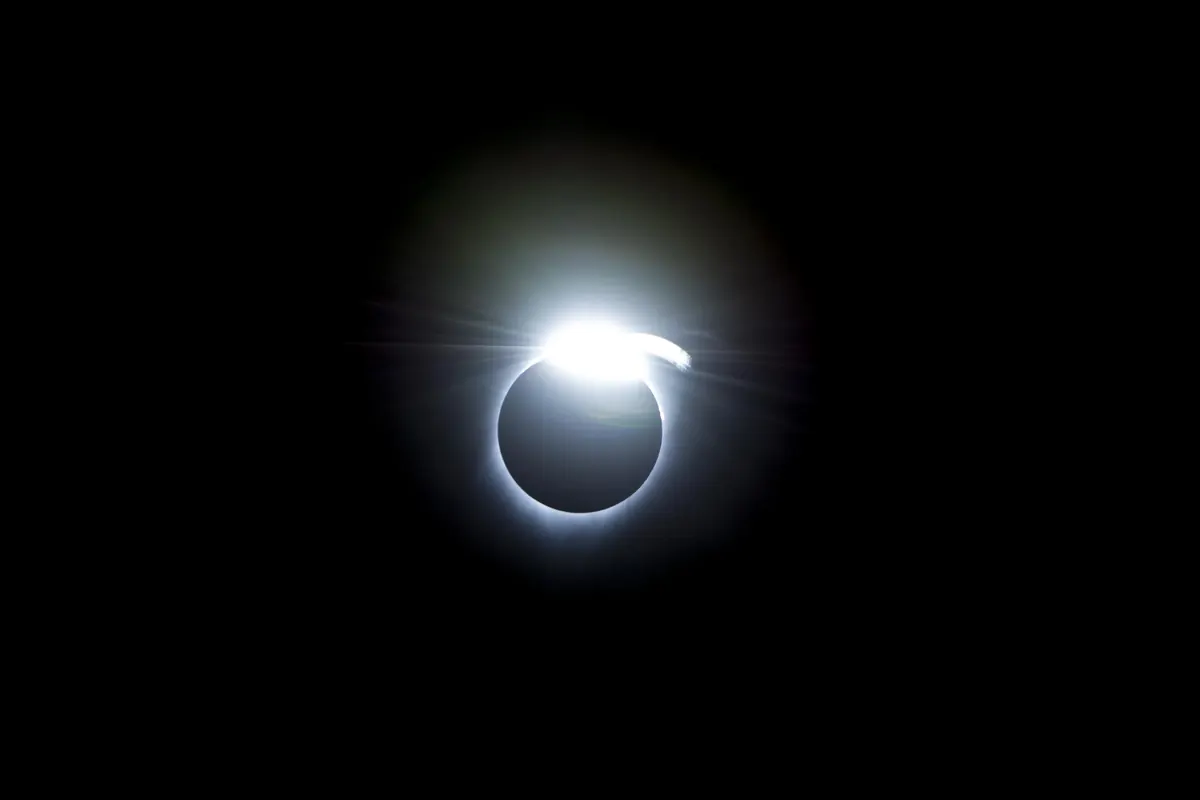
In a total eclipse the moon covers the sun completely, the sky darkens like late twilight and the sun's faint outer atmosphere, the corona, appears. In an annular eclipse the moon is too far away to cover the whole sun and leaves a bright "ring of fire". Both are seen only along a narrow track a few hundred kilometers wide; on either side of it, and far beyond, people see a partial eclipse, with a bite taken out of the sun. Even a 90% partial eclipse leaves the day surprisingly bright. (When Earth's shadow falls on the moon instead, it is a lunar eclipse.)
Why there isn't an eclipse every month
The moon passes between Earth and the sun at every new moon, but its orbit is tilted about 5° to Earth's.[6] Most months it passes a little above or below the sun. Only when a new moon falls near the points where the two orbits cross does its shadow touch Earth. That happens two to five times a year, but the shadow's darkest part is so narrow that any one city sees a total eclipse only rarely. In New York, for example, the next total solar eclipse is on May 1, 2079.
Eclipses, Sutak and pregnancy
In many traditions an eclipse is a time for special practices: in Hinduism the Sutak period before an eclipse, in Islam the eclipse prayer. For those, follow your local panchang, temple, mosque or community; the times on this page are astronomical. Two common worries have no basis in science: an eclipse does not harm pregnant women or unborn babies, and food cooked or left out during an eclipse is not poisoned. The only real danger is to the eyes, from looking at the uncovered sun.[53]
How we calculate
For each place we calculate the positions of the sun and moon as seen from its exact coordinates, which gives the start, deepest moment and end of the eclipse, how much of the sun's disk is covered, and how long totality lasts. Our dates and types match NASA's eclipse catalog,[11] and the greatest-eclipse point of August 2, 2027 matches the published figures.[32] Times assume a flat horizon; city data come from GeoNames.[37]
Frequently asked questions
How long does a solar eclipse last?
From the first bite out of the sun to the last, usually two to three hours; totality itself lasts only a few minutes. On August 2, 2027, for example, the whole eclipse takes about 2 hours 46 minutes in Luxor, Egypt, with 6 minutes 25 seconds of totality, and about 1 hour 56 minutes in London, where it stays partial. The exact times for your city are in the tool at the top of this page.
What's the difference between a solar and a lunar eclipse?
In a solar eclipse the moon passes between the sun and Earth and blocks the sun; it can only happen at new moon, lasts a few hours and is seen from a limited part of the world. In a lunar eclipse Earth passes between the sun and the moon, and Earth's shadow darkens the full moon, often turning it red; it happens at full moon and is visible from the whole night side of Earth at once. A lunar eclipse is safe to watch with the naked eye; a solar eclipse never is, except during totality.
Sources
- [6]Moon Fact SheetNASA Space Science Data Coordinated Archive (NSSDCA)
- [11]Five Millennium Catalog of Solar Eclipses: 2001 to 2100Fred Espenak, NASA Goddard Space Flight Center
- [13]Eclipse SafetyNASA Science
- [32]Total Solar Eclipse of 2027 Aug 02Fred Espenak, EclipseWise
- [37]GeoNames geographical databaseGeoNames (CC BY 4.0)
- [53]Eclipse MisconceptionsNASA, Eclipse 2017 website (Web Archive copy)
- Times are calculated with Astronomy Engine for each place's own time zone (how we check our numbers).
Every source on the site, and what we took from each: Sources.
Last updated: