Showing New York City, New York · default city
Place list: GeoNames (CC BY 4.0). Times are for the city center and a flat horizon.
The moon today in New York City, New York
Saturday, November 7, 2026 · times in local time (EST)
Today the moon is a waning crescent, 3% illuminated and shrinking. The next full moon is on Tue, Nov 24.
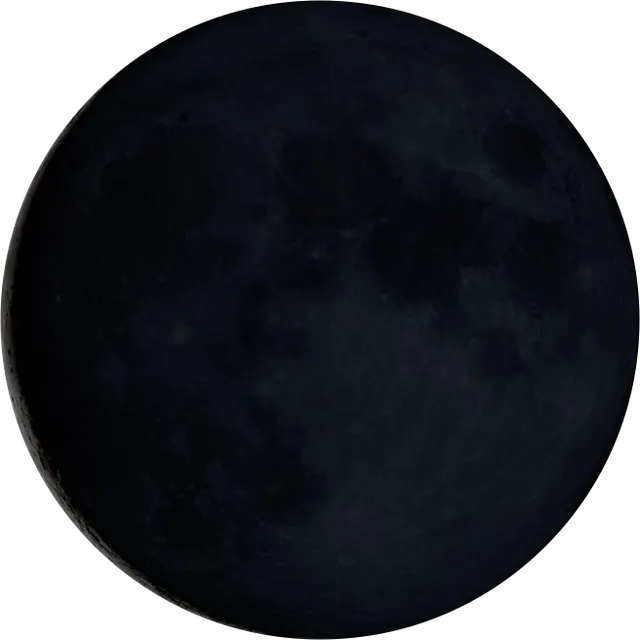
Moon phase
Waning Crescent
3% illuminated · waning (shrinking)
27.8 days since the new moon
- Moonrise
- 4:55 AM
- ESE · 107°
- Moonset
- 3:33 PM
- WSW · 250°
- Next full moon
- Tue, Nov 24
- Beaver Moon · 9:54 AM · in 17 days
- Distance
- 243,600 mi
- 392,100 km from Earth
Next new moon: Mon, Nov 9, 2:02 AM
Where is the moon right now?
16° above the horizon, toward the SE
The moon is up, but the sky is bright: look for a pale moon in the daytime sky. Moonset: Sat, Nov 7, 3:33 PM, toward the WSW (250°).
Direction is measured from true north: 90° is due east, 180° due south. Updated every minute for New York City, New York.
The moon's path tonight
How high the moon is above the horizon in New York City, New York from noon to noon. The background shows daylight, twilight and full darkness, so you can see when the moon is up in a dark sky. Tonight the moon is not above the horizon while the sky is dark.
Moonrise, moonset and phases for the next 30 days
For New York City, New York, in local time. The moon rises about 50 minutes later each day on average, so about once a month there is a day with no moonrise and one with no moonset.
| Date | Phase | Moonrise | Moonset |
|---|---|---|---|
| Sat, Nov 7 | Waning Crescent3% | 4:55 AMESE | 3:33 PMWSW |
| Sun, Nov 8 | Waning Crescent1% | 6:01 AMESE | 4:01 PMWSW |
| Mon, Nov 9 | New Moon0% | 7:07 AMESE | 4:33 PMWSW |
| Tue, Nov 10 | Waxing Crescent2% | 8:11 AMSE | 5:11 PMSW |
| Wed, Nov 11 | Waxing Crescent6% | 9:11 AMSE | 5:56 PMSW |
| Thu, Nov 12 | Waxing Crescent11% | 10:04 AMSE | 6:48 PMSW |
| Fri, Nov 13 | Waxing Crescent17% | 10:50 AMSE | 7:45 PMSW |
| Sat, Nov 14 | Waxing Crescent25% | 11:29 AMESE | 8:46 PMWSW |
| Sun, Nov 15 | Waxing Crescent33% | 12:01 PMESE | 9:49 PMWSW |
| Mon, Nov 16 | Waxing Crescent43% | 12:28 PMESE | 10:52 PMWSW |
| Tue, Nov 17 | First Quarter52% | 12:52 PMESE | 11:55 PMWSW |
| Wed, Nov 18 | Waxing Gibbous62% | 1:14 PME | – |
| Thu, Nov 19 | Waxing Gibbous72% | 1:35 PME | 1:00 AMW |
| Fri, Nov 20 | Waxing Gibbous81% | 1:58 PME | 2:06 AMW |
| Sat, Nov 21 | Waxing Gibbous89% | 2:23 PMENE | 3:15 AMWNW |
| Sun, Nov 22 | Waxing Gibbous95% | 2:52 PMENE | 4:28 AMWNW |
| Mon, Nov 23 | Waxing Gibbous99% | 3:28 PMENE | 5:46 AMWNW |
| Tue, Nov 24 | Full Moon100% | 4:15 PMNE | 7:05 AMNW |
| Wed, Nov 25 | Waning Gibbous98% | 5:14 PMNE | 8:21 AMNW |
| Thu, Nov 26 | Waning Gibbous93% | 6:25 PMNE | 9:28 AMNW |
| Fri, Nov 27 | Waning Gibbous86% | 7:43 PMENE | 10:23 AMNW |
| Sat, Nov 28 | Waning Gibbous77% | 9:01 PMENE | 11:05 AMWNW |
| Sun, Nov 29 | Waning Gibbous67% | 10:16 PMENE | 11:38 AMWNW |
| Mon, Nov 30 | Waning Gibbous56% | 11:28 PME | 12:06 PMWNW |
| Tue, Dec 1 | Last Quarter45% | – | 12:30 PMW |
| Wed, Dec 2 | Waning Crescent35% | 12:36 AME | 12:52 PMW |
| Thu, Dec 3 | Waning Crescent25% | 1:42 AME | 1:14 PMW |
| Fri, Dec 4 | Waning Crescent17% | 2:47 AMESE | 1:37 PMWSW |
| Sat, Dec 5 | Waning Crescent10% | 3:53 AMESE | 2:03 PMWSW |
| Sun, Dec 6 | Waning Crescent5% | 4:58 AMESE | 2:33 PMWSW |
Upcoming moon phases
The exact moments of the four main phases, in your local time. Full moons carry their traditional North American names.
New Moon
Mon, Nov 9, 2:02 AM · in 2 days
First Quarter
Tue, Nov 17, 6:48 AM · in 10 days
Full MoonBeaver Moon
Tue, Nov 24, 9:54 AM · in 17 days
Last Quarter
Tue, Dec 1, 1:09 AM · in 24 days
New Moon
Tue, Dec 8, 7:52 PM · in 32 days
First Quarter
Thu, Dec 17, 12:43 AM · in 40 days
Full MoonCold Moon
Wed, Dec 23, 8:28 PM · in 47 days
Last Quarter
Wed, Dec 30, 2:00 PM · in 53 days
Moon phases 2026
Every new moon, first quarter, full moon and last quarter of the year in New York City, New York, local time, with the length of each lunar cycle from new moon to new moon.
| New moon | First quarter | Full moon | Last quarter | Cycle length |
|---|---|---|---|---|
| – | – | Jan 35:03 AM | Jan 1010:49 AM | 29d 18h 09m |
| Jan 182:52 PM | Jan 2511:47 PM | Feb 15:09 PM | Feb 97:43 AM | 29d 16h 09m |
| Feb 177:01 AM | Feb 247:28 AM | Mar 36:38 AM | Mar 115:39 AM | 29d 13h 22m |
| Mar 189:24 PM | Mar 253:18 PM | Apr 110:12 PM | Apr 1012:52 AM | 29d 10h 28m |
| Apr 177:52 AM | Apr 2310:32 PM | May 11:23 PM | May 95:11 PM | 29d 8h 09m |
| May 164:01 PM | May 237:11 AM | May 314:45 AM | Jun 86:00 AM | 29d 6h 53m |
| Jun 1410:54 PM | Jun 215:55 PM | Jun 297:57 PM | Jul 73:29 PM | 29d 6h 49m |
| Jul 145:44 AM | Jul 217:06 AM | Jul 2910:36 AM | Aug 510:21 PM | 29d 7h 53m |
| Aug 121:37 PM | Aug 1910:46 PM | Aug 2812:19 AM | Sep 43:51 AM | 29d 9h 50m |
| Sep 1011:27 PM | Sep 184:44 PM | Sep 2612:49 PM | Oct 39:25 AM | 29d 12h 23m |
| Oct 1011:50 AM | Oct 1812:13 PM | Oct 2612:12 AM | Nov 13:28 PM | 29d 15h 12m |
| Nov 92:02 AM | Nov 176:48 AM | Nov 249:54 AM | Dec 11:09 AM | 29d 17h 50m |
| Dec 87:52 PM | Dec 1712:43 AM | Dec 238:28 PM | Dec 302:00 PM | 29d 19h 33m |
The cycle you are in now is highlighted. Cycles differ by several hours; the explanation below says why.
Traditional calendars
Tithi, Purnima, Amavasya and the Hijri date
The Hindu and Islamic calendars both follow the moon. Below is what the moon itself is doing, worked out for New York City, New York. Fasts, festivals and the official start of a month follow each tradition's own rules.
Hindu calendar
- Tithi now
- Krishna Chaturdashi (14th of the waning fortnight), until Sun, Nov 8, 12:58 AM
- Next Purnima tithi
- Mon, Nov 23, 1:13 PM – Tue, Nov 24, 9:54 AM
- Next Amavasya tithi
- Sun, Nov 8, 12:58 AM – Mon, Nov 9, 2:02 AM
- Chandrodaya (moonrise)
- 4:55 AM on Sat, Nov 7
A tithi is the time the moon takes to move 12° farther from the sun, so its length varies.[51] Times here are astronomical. Which day a fast or festival falls on also depends on panchang rules, such as the tithi at sunrise; check your local panchang or temple.
Islamic calendar
- Hijri date
- 27 Jumada al-Ula 1448 AH (Umm al-Qura calendar)
- New moon
- Mon, Nov 9, 2:02 AM
- New crescent from New York City
- Likely visible on the evening of Wed, Nov 11, after sunset at 4:41 PM (moon 9° high, low in the west)
The crescent estimate is astronomical: the moon at least 5° above the horizon and 8° from the sun at sunset. Many communities begin a month only after the crescent is actually sighted, locally or by a national committee, so dates can differ by a day from the Umm al-Qura calendar used in Saudi Arabia. For Ramadan and Eid, follow your local moon sighting committee or mosque.
Moonrise and moonset today around the world
The phase is the same everywhere (waning crescent, 3% lit), but rise and set times are not. Each city is shown in its own local time and date. Tap a city for its full night.
| City | Moonrise | Moonset |
|---|---|---|
| New York City, New York | 4:55 AM ESE | 3:33 PM WSW |
| Miami, Florida | 5:00 AM ESE | 4:23 PM WSW |
| Chicago, Illinois | 4:54 AM ESE | 3:27 PM WSW |
| Houston, Texas | 5:08 AM ESE | 4:20 PM WSW |
| Denver, Colorado | 5:03 AM ESE | 3:41 PM WSW |
| Phoenix, Arizona | 5:22 AM ESE | 4:22 PM WSW |
| Los Angeles, California | 4:49 AM ESE | 3:46 PM WSW |
| Seattle, Washington | 5:31 AM ESE | 3:34 PM WSW |
| Anchorage, Alaska | 7:16 AM ESE | 3:32 PM SW |
| Honolulu, Hawaii | 5:17 AM ESE | 4:48 PM WSW |
| Toronto, Ontario, Canada | 5:23 AM ESE | 3:49 PM WSW |
| Vancouver, British Columbia, Canada | 6:39 AM ESE | 4:32 PM WSW |
| London, UK | 5:07 AM ESE | 3:09 PM WSW |
| Manchester, UK | 5:20 AM ESE | 3:11 PM WSW |
| Edinburgh, UK | 5:31 AM ESE | 3:07 PM WSW |
| Dublin, Ireland | 5:37 AM ESE | 3:28 PM WSW |
| Delhi, India | 4:38 AM ESE | 4:05 PM WSW |
| Mumbai, Maharashtra, India | 4:47 AM E | 4:34 PM WSW |
| Bengaluru, Karnataka, India | 4:23 AM E | 4:21 PM WSW |
| Hyderabad, Telangana, India | 4:23 AM E | 4:13 PM WSW |
| Chennai, Tamil Nadu, India | 4:12 AM E | 4:10 PM WSW |
| Kolkata, West Bengal, India | 3:46 AM E | 3:27 PM WSW |
| Karachi, Pakistan | 4:47 AM ESE | 4:22 PM WSW |
| Dubai, United Arab Emirates | 4:36 AM ESE | 4:09 PM WSW |
| Singapore | 4:55 AM E | 5:15 PM WSW |
| Manila, Philippines | 3:54 AM E | 3:51 PM WSW |
| Sydney, New South Wales, Australia | 4:14 AM E | 5:35 PM WSW |
| Melbourne, Victoria, Australia | 4:35 AM ESE | 6:06 PM WSW |
| Brisbane, Queensland, Australia | 3:12 AM E | 4:19 PM WSW |
| Perth, Western Australia, Australia | 3:40 AM ESE | 4:59 PM WSW |
| Adelaide, South Australia, Australia | 4:34 AM ESE | 5:59 PM WSW |
| Darwin, Northern Territory, Australia | 4:24 AM E | 5:06 PM WSW |
| Auckland, New Zealand | 5:01 AM ESE | 7:04 PM WSW |
| Lagos, Nigeria | 4:54 AM ESE | 5:03 PM WSW |
| Nairobi, Kenya | 4:30 AM E | 4:54 PM WSW |
| Johannesburg, South Africa | 3:44 AM ESE | 4:57 PM WSW |
| Cape Town, South Africa | 4:15 AM ESE | 5:48 PM WSW |
Why the moon has phases
The sun always lights half of the moon. As the moon circles Earth, we see that lit half from a changing angle: none of it at the new moon, when the moon sits roughly between us and the sun, all of it at the full moon, when it is on the far side of Earth, and part of it in between.[7] A full cycle, from one new moon to the next, takes 29.53 days on average,[6] but single cycles run anywhere from about 29.3 to 29.8 days because the sun's pull speeds the moon up and slows it down.[5]
The four main phases (new moon, first quarter, full moon and last quarter) are single moments. Calendars, including the one above, give the whole local day of that moment the phase's name; on the days in between, the moon is a crescent or gibbous, waxing or waning.
Waxing or waning? How to tell from where you are
A waxing moon is growing toward full; a waning moon is shrinking toward new. Which side is lit depends on where on Earth you stand, because the moon looks rotated from different latitudes:
- Northern Hemisphere (US, Canada, UK, Europe, most of India): lit on the right means waxing, lit on the left means waning. An old memory aid: a waxing moon looks like the curve of a D, a waning one like a C.
- Southern Hemisphere (Australia, New Zealand, South Africa, Argentina): the other way round. Lit on the left is waxing, lit on the right is waning.
- Near the equator (Singapore, Nairobi, southern India): the crescent lies on its back like a boat, lit from below in the evening and from above before dawn.
There is a simpler test that works everywhere: a moon you see in the evening sky soon after sunset is waxing; one still up in the morning sky after sunrise is waning. The picture at the top of this page is turned the way the moon really looks from the city you choose, at the time shown under it.
Is the moon phase the same everywhere?
Yes. The phase depends only on where the moon is in its orbit, so at any given moment it is the same for everyone on Earth. Three things do change with your location: the local date and time of a phase (a full moon at 2 a.m. in London happens the evening before in New York), the way the moon is turned in the sky, and when it rises and sets. That's why the moon on your birthday depends on where you were born.
Why the moon rises later every day
While Earth turns once, the moon moves about a thirtieth of the way along its orbit in the same direction, so Earth has to turn a little extra before the moon comes back over the horizon. In New York over the next month, moonrise comes on average 52 minutes later each day, but the gap swings from 22 to 78 minutes, because the angle of the moon's path to the horizon keeps changing. In autumn the gap gets especially small around the full moon, which is why the Harvest Moon seems to rise at nearly the same time several evenings in a row.
Full moon names
Each month's full moon has a traditional name from North American folklore, such as the Wolf Moon in January and the Strawberry Moon in June. The full moon closest to the September equinox is the Harvest Moon, the one after it the Hunter's Moon, and a second full moon in the same calendar month is a Blue Moon.[17] The next full moon, on November 24, is the Beaver Moon. These names follow Northern Hemisphere seasons, so they don't really fit in Australia or New Zealand.
How we calculate
Every number on this page is calculated for the exact coordinates of the place you choose: the phase and illumination from the positions of the sun and moon, moonrise and moonset when the moon's upper edge crosses a flat horizon, with the bending of light by the atmosphere included. Our phase times match the U.S. Naval Observatory's tables[4] to within about a minute. The moon pictures are NASA's own renderings of the moon in each phase,[50] turned to match your sky, and the place list comes from GeoNames.[37]
Frequently asked questions
Why can't I see the moon tonight?
Usually for one of three reasons. Around the new moon it is too close to the sun and lost in its glare for a day or two on either side. Otherwise it may simply not be up yet or already set: a waning moon rises late at night or after midnight, and a young crescent sets soon after sunset. And when it is low, buildings, trees or haze near the horizon can hide it. Check the moonrise and moonset times and the path chart above for your city.
Does the moon wax or wane first?
It waxes first. After the new moon, the lit part grows night by night (waxing crescent, first quarter, waxing gibbous) until the full moon, then shrinks again (waning gibbous, last quarter, waning crescent) back to the next new moon. One full cycle takes about 29.5 days.
Is the moon bigger tonight?
Its real size in the sky changes a little, because its orbit is an oval: at its closest (about 356,000 km, 221,000 miles) it looks about 14% wider than at its farthest (about 407,000 km, 253,000 miles). That's what a supermoon is. The much bigger moon you sometimes see near the horizon is an illusion of the eye: measured, the rising moon is no larger than when it is high in the sky. The distance card above shows how far it is today.
Sources
- [4]Dates of Primary Phases of the MoonU.S. Naval Observatory (USNO), Astronomical Applications Department
- [5]Six Millennium Catalog of Phases of the MoonFred Espenak, NASA Goddard Space Flight Center
- [6]Moon Fact SheetNASA Space Science Data Coordinated Archive (NSSDCA)
- [7]Moon PhasesNASA Science
- [17]Full Moon NamesThe Old Farmer's Almanac (published since 1792)
- [37]GeoNames geographical databaseGeoNames (CC BY 4.0)
- [50]Moon Phase and Libration, 2026NASA Scientific Visualization Studio (SVS)
- [51]Tithi: definitionsWisdom Library (Jyotisha and Sanskrit dictionary definitions)
- Times are calculated with Astronomy Engine for each place's own time zone (how we check our numbers).
Every source on the site, and what we took from each: Sources.
Last updated: