Showing New York City, New York · default city
Place list: GeoNames (CC BY 4.0). Times are for the city center and a flat horizon.
Pick your birthday in the date box and your birthplace in the city box above. Without a time we use midday.
The moon today
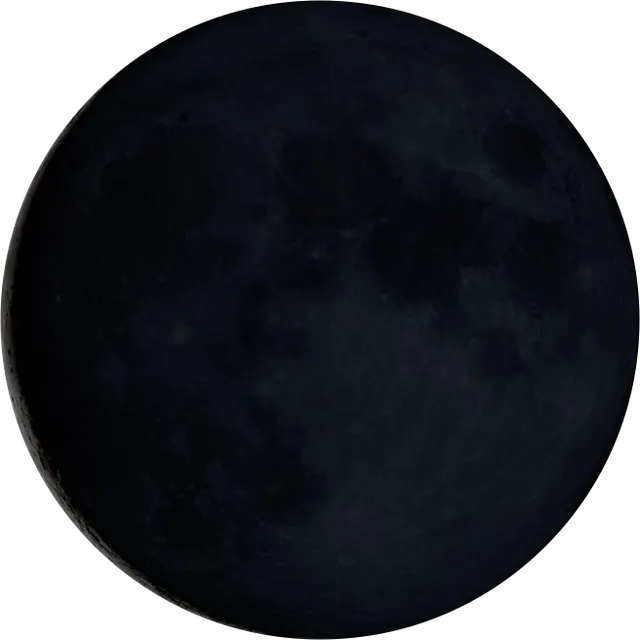
Saturday, November 7, 2026
Waning Crescent
3% illuminated · 28 days old · waning
The nearest full moon came 13 days before you were born.
Your birth full moon:Hunter's Moon(Oct 26, 2026)
Moonrise that day in New York City: 4:55 AM
Free to download: a phone wallpaper (1080 × 1920) or an A4 poster at print quality (300 dpi). The moon picture is NASA's public-domain rendering of that phase.
Compare with your partner
Enter a second birthday to see both moons side by side.
The moon on your next birthdays
The phase on the evening of each birthday in New York City. Your birthday next falls on a full moon in 2041.
- 2026Waning Crescent, 2%
- 2027Waxing Gibbous, 66%
- 2028Waning Gibbous, 70%
- 2029Waxing Crescent, 5%
- 2030Waxing Gibbous, 96%
Your 19-year moon
Every 19 years the moon's phases fall on almost the same calendar dates again, so on your 19th, 38th and 57th birthdays the moon looks nearly as it did when you were born.
- Age 19 (2045)Waning Crescent, 2%
- Age 38 (2064)Waning Crescent, 2%
- Age 57 (2083)Waning Crescent, 7%
Why the moon is different on every birthday
The moon goes through its phases every 29.53 days on average,[6] so a year of 365 days holds about 12.4 lunar cycles. After one year the moon is roughly 11 days further along its cycle than it was on your last birthday: a full moon one year turns into a waning crescent the next. Individual cycles also vary by several hours,[5] which is why the pattern is never perfectly regular.
The exception is the 19-year cycle. Nineteen years come to within a couple of hours of 235 lunar cycles, so the phases repeat on almost the same calendar dates. Ancient calendar makers used this rhythm, and it means your 19th, 38th and 57th birthdays bring back nearly the same moon you were born under.
Why your birthplace and time matter
The phase itself is the same everywhere at a given moment, but the date isn't: if you were born late at night, the moon a few hours later might belong to the next calendar day. The moon also looks turned differently depending on where you are: in the Northern Hemisphere a growing moon is lit on the right, in the Southern Hemisphere on the left. That's why this tool asks for your birthplace and, if you know it, your time of birth.
What about NASA's moon tool?
NASA's Dial-A-Moon shows the moon for a time you choose, using NASA's yearly moon visualizations, which cover 2011 to 2026.[56] If you were born earlier, this page fills the gap: it works for any date from 1900 to 2100. The moon pictures here are NASA's own renderings of each phase,[50] turned to match the sky over your birthplace.
Your birth full moon
Each month's full moon has a traditional North American name, from the Wolf Moon in January to the Cold Moon in December, with the Harvest Moon nearest the September equinox.[17] We show the full moon closest to your birthday, before or after it, and its name.
Does the moon phase at birth say anything about you?
There's no scientific evidence that it does, and we don't offer personality readings. A common related belief, that more babies are born around the full moon, has been tested: a study of 564,039 births in North Carolina found no difference across the eight phases of the moon.[8] The moon on your birthday is simply a lovely piece of personal history.
Frequently asked questions
Is a full moon on your birthday lucky?
Many people like the idea, and in some traditions a full moon is a time of celebration, but there's no evidence that the moon on your birthday brings luck, good or bad. What is true is that it's rare: a given date falls on a full moon only three to five times in a century, often 19 years apart. November 24, for example, gets one in 1996, 2007, 2026 and 2045. The tool above shows the next year it happens for your birthday.
How do I save my birthday moon as a wallpaper or poster?
Press "Phone wallpaper" or "Printable poster (A4)" under your result. On a computer the picture goes to your downloads folder. On an iPhone it opens as a preview: tap the share button and choose "Save Image", then set it from the Photos app. On Android it saves to your downloads or gallery. The wallpaper is 1080 × 1920 pixels, the shape of a phone screen; the poster is A4 at 300 dpi (2480 × 3508 pixels), sharp enough to print and frame.
Sources
- [5]Six Millennium Catalog of Phases of the MoonFred Espenak, NASA Goddard Space Flight Center
- [6]Moon Fact SheetNASA Space Science Data Coordinated Archive (NSSDCA)
- [8]The effect of the lunar cycle on frequency of births and birth complicationsArliss, Kaplan and Galvin; American Journal of Obstetrics and Gynecology, 2005 (PubMed)
- [17]Full Moon NamesThe Old Farmer's Almanac (published since 1792)
- [37]GeoNames geographical databaseGeoNames (CC BY 4.0)
- [50]Moon Phase and Libration, 2026NASA Scientific Visualization Studio (SVS)
- [56]Moon Phase and Libration Gallery (Dial-A-Moon)NASA Scientific Visualization Studio (SVS)
- Times are calculated with Astronomy Engine for each place's own time zone (how we check our numbers).
Every source on the site, and what we took from each: Sources.
Last updated: