Showing New York City, New York · default city
Place list: GeoNames (CC BY 4.0). Times are for the city center and a flat horizon.
The next lunar eclipse you can see from New York City, New York
Penumbral lunar eclipse
Saturday, February 20, 2027
in 106 days
Only part of it is visible: the moon is below the horizon for the rest from New York City. Deepest at 6:12 PM. A penumbral eclipse only dims the moon slightly; many people don't notice it.
4:11 PM8:13 PM
Striped: the moon is below the horizon from here.
- Faint shading (penumbra)
- 4:11 PM – 8:13 PM
Next blood moon from New York City
Monday, June 25, 2029. The moon is red from 10:30 PM to 12:13 AM. Until then, the eclipses visible from here are only partial or penumbral.
Is there a blood moon in 2027?
No. 2027 has 3 lunar eclipses (penumbral on February 20, penumbral on July 18, penumbral on August 17), but none of them is total, so the moon won't turn red. The next blood moon is on December 31, 2028, with 72 minutes of totality.[1]
Dates in UTC; in the Americas the same eclipse can fall on the evening before.
Where the next lunar eclipses are visible
A lunar eclipse can be seen from anywhere the moon is above the horizon at the time: roughly the half of Earth that is in night. The maps shade where the whole eclipse is visible and where the moon rises or sets during it.
July 18, 2027: penumbral lunar eclipse
greatest 16:02 UTC · in 254 daysAugust 17, 2027: penumbral lunar eclipse
greatest 07:13 UTC · in 283 daysEvery lunar eclipse to 2030
A lunar eclipse is visible from the whole night side of Earth at once. Next to each are the cities from our list where the moon is up for most of the main stage (for total eclipses, the red part).
| Date (UTC) | Type | Seen well from |
|---|---|---|
| Feb 20, 2027 | Penumbral | New York City, Toronto, London, Manchester, Edinburgh, Dublin, Delhi and 12 more |
| Jul 18, 2027 | Penumbral | Delhi, Mumbai, Bengaluru, Hyderabad, Chennai, Kolkata, Karachi and 13 more |
| Aug 17, 2027 | Penumbral | New York City, Miami, Chicago, Houston, Denver, Phoenix, Los Angeles and 6 more |
| Jan 12, 2028 | Partial | New York City, Miami, Chicago, Houston, Denver, Phoenix, Los Angeles and 10 more |
| Jul 6, 2028 | Partial | Delhi, Mumbai, Bengaluru, Hyderabad, Chennai, Kolkata, Karachi and 14 more |
| Dec 31, 2028 | Totalblood moon, 72 min | Anchorage, Honolulu, London, Manchester, Edinburgh, Dublin, Delhi and 17 more |
| Jun 26, 2029 | Totalblood moon, 103 min | New York City, Miami, Chicago, Houston, Denver, Phoenix, Los Angeles and 9 more |
| Dec 20, 2029 | Totalblood moon, 55 min | New York City, Miami, Chicago, Toronto, London, Manchester, Edinburgh and 14 more |
| Jun 15, 2030 | Partial | Delhi, Mumbai, Bengaluru, Hyderabad, Chennai, Kolkata, Karachi and 14 more |
| Dec 9, 2030 | Penumbral | New York City, Chicago, Toronto, London, Manchester, Edinburgh, Dublin and 13 more |
The next blood moon (December 31, 2028) around the world
When the moon is red in each city's local time, and whether it is above the horizon then. Tap a city for all its eclipses.
| City | Red moon (local) | Visible? |
|---|---|---|
| New York City, New York | Dec 31, 11:15 AM – 12:28 PM | Not visible |
| Miami, Florida | Dec 31, 11:15 AM – 12:28 PM | Not visible |
| Chicago, Illinois | Dec 31, 10:15 AM – 11:28 AM | Not visible |
| Houston, Texas | Dec 31, 10:15 AM – 11:28 AM | Not visible |
| Denver, Colorado | Dec 31, 9:15 AM – 10:28 AM | Not visible |
| Phoenix, Arizona | Dec 31, 9:15 AM – 10:28 AM | Not visible |
| Los Angeles, California | Dec 31, 8:15 AM – 9:28 AM | Not visible |
| Seattle, Washington | Dec 31, 8:15 AM – 9:28 AM | Not visible |
| Anchorage, Alaska | Dec 31, 7:15 AM – 8:28 AM | All of it |
| Honolulu, Hawaii | Dec 31, 6:15 AM – 7:28 AM | Part of it |
| Toronto, Ontario, Canada | Dec 31, 11:15 AM – 12:28 PM | Not visible |
| Vancouver, British Columbia, Canada | Dec 31, 9:15 AM – 10:28 AM | Not visible |
| London, UK | Dec 31, 4:15 PM – 5:28 PM | All of it |
| Manchester, UK | Dec 31, 4:15 PM – 5:28 PM | All of it |
| Edinburgh, UK | Dec 31, 4:15 PM – 5:28 PM | All of it |
| Dublin, Ireland | Dec 31, 4:15 PM – 5:28 PM | All of it |
| Delhi, India | Dec 31, 9:45 PM – 10:58 PM | All of it |
| Mumbai, Maharashtra, India | Dec 31, 9:45 PM – 10:58 PM | All of it |
| Bengaluru, Karnataka, India | Dec 31, 9:45 PM – 10:58 PM | All of it |
| Hyderabad, Telangana, India | Dec 31, 9:45 PM – 10:58 PM | All of it |
| Chennai, Tamil Nadu, India | Dec 31, 9:45 PM – 10:58 PM | All of it |
| Kolkata, West Bengal, India | Dec 31, 9:45 PM – 10:58 PM | All of it |
| Karachi, Pakistan | Dec 31, 9:15 PM – 10:28 PM | All of it |
| Dubai, United Arab Emirates | Dec 31, 8:15 PM – 9:28 PM | All of it |
| Singapore | Jan 1, 12:15 AM – 1:28 AM | All of it |
| Manila, Philippines | Jan 1, 12:15 AM – 1:28 AM | All of it |
| Sydney, New South Wales, Australia | Jan 1, 3:15 AM – 4:28 AM | All of it |
| Melbourne, Victoria, Australia | Jan 1, 3:15 AM – 4:28 AM | All of it |
| Brisbane, Queensland, Australia | Jan 1, 2:15 AM – 3:28 AM | All of it |
| Perth, Western Australia, Australia | Jan 1, 12:15 AM – 1:28 AM | All of it |
| Adelaide, South Australia, Australia | Jan 1, 2:45 AM – 3:58 AM | All of it |
| Darwin, Northern Territory, Australia | Jan 1, 1:45 AM – 2:58 AM | All of it |
| Auckland, New Zealand | Jan 1, 5:15 AM – 6:28 AM | Part of it |
| Lagos, Nigeria | Dec 31, 5:15 PM – 6:28 PM | Not visible |
| Nairobi, Kenya | Dec 31, 7:15 PM – 8:28 PM | All of it |
| Johannesburg, South Africa | Dec 31, 6:15 PM – 7:28 PM | Part of it |
| Cape Town, South Africa | Dec 31, 6:15 PM – 7:28 PM | Not visible |
Why the moon turns red
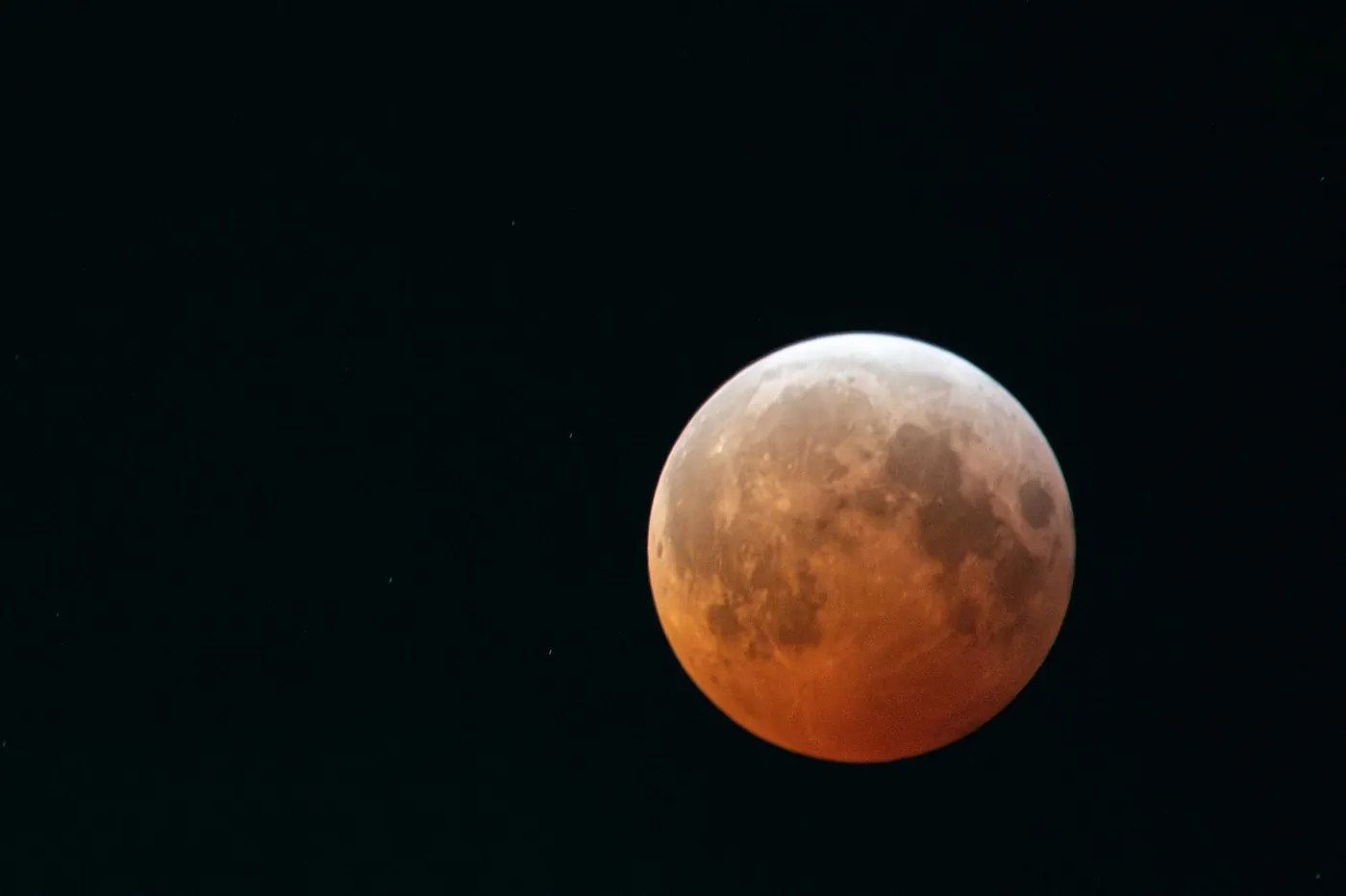
In a total lunar eclipse, Earth sits exactly between the sun and the full moon, and the moon moves into Earth's shadow. It doesn't go black, because some sunlight still reaches it: the light that passes through the edge of Earth's atmosphere is bent into the shadow, and on the way the blue part of it is scattered out, leaving red and orange. NASA describes it as if all the world's sunrises and sunsets were projected onto the moon; the more dust or clouds in the atmosphere, the redder it looks.[54]
No two blood moons look the same. Astronomers rate them on the Danjon scale, from L0, so dark the moon almost disappears, to L4, a bright copper-orange. After big volcanic eruptions, which fill the upper atmosphere with fine dust, eclipses can stay very dark for a few years.[3]
Total, partial and penumbral
Earth's shadow has two parts: a dark core, the umbra, and a pale outer fringe, the penumbra. When the whole moon passes into the umbra, the eclipse is total and the moon turns red. When only part of it does, the eclipse is partial: a dark bite is taken out of the moon. When the moon only grazes the penumbra, the eclipse is penumbral; the moon dims so slightly that most people don't notice anything.
Why there isn't an eclipse every full moon
A lunar eclipse can only happen at full moon, when the moon is opposite the sun. But the moon's orbit is tilted about 5° to Earth's,[6] so most full moons pass a little above or below Earth's shadow. Only when a full moon falls near the points where the two orbits cross does the moon go through it. That gives two lunar eclipses in most years, sometimes three or four, but many of them are only partial or penumbral.
How to watch
A lunar eclipse is completely safe to look at: unlike a solar eclipse, you don't need glasses or any special equipment, though binoculars or a small telescope show the colors better.[54] Find a spot with a clear view of the moon away from bright lights. The red stage is the highlight; the partial stages before and after are worth watching too, as the shadow creeps across the moon's face. For photos, use a tripod: the eclipsed moon is far fainter than a normal full moon, so you'll need much longer exposures.
Eclipses and religious practice
Many traditions mark a lunar eclipse: in Hinduism with the Sutak period and in Islam with the eclipse prayer, for example. For those, follow your local panchang, temple, mosque or community; the times on this page are astronomical.
How we calculate
The start and end of each stage come from the positions of the sun, moon and Earth's shadow; our dates and types match NASA's eclipse catalog.[1] Whether you can see a stage depends only on whether the moon is above your horizon at the time, which we work out for your exact location every two minutes. City data come from GeoNames.[37]
Frequently asked questions
How long does a lunar eclipse last?
A total lunar eclipse takes about five and a half to six hours from the first faint dimming to the end, but the parts you really notice are shorter: the moon is partly in Earth's dark shadow for about three and a half hours, and fully red for usually 45 minutes to an hour and a half. The blood moon of June 26, 2029 is a long one, red for about 1 hour 43 minutes.
How often is there a blood moon?
By our count there are 17 total lunar eclipses between 2026 and 2045, a little under one a year on average, but they come unevenly: there are two in 2029 and none at all in 2027. Any one place sees only some of them, because the moon has to be above your horizon at the time.
Sources
- [1]Five Millennium Catalog of Lunar Eclipses: 2001 to 2100Fred Espenak, NASA Goddard Space Flight Center
- [3]Danjon Scale of Lunar Eclipse BrightnessFred Espenak, NASA Goddard Space Flight Center
- [6]Moon Fact SheetNASA Space Science Data Coordinated Archive (NSSDCA)
- [37]GeoNames geographical databaseGeoNames (CC BY 4.0)
- [54]What You Need to Know about the Lunar EclipseNASA, moon.nasa.gov (2019, Web Archive copy)
- Times are calculated with Astronomy Engine for each place's own time zone (how we check our numbers).
Every source on the site, and what we took from each: Sources.
Last updated: